· corporate-travel · agentic-commerce · case-study
The $53 Line Item: What Happens When an Agent Books Your Corporate Travel
Corporate travel is the most rule-bound purchase in business — which makes it the perfect job for an agent. Policy-faithful bookings, one tap to approve the corporate card, and about $53 saved every time a human doesn’t have to do it.
David Broderick Founder & Head of Agents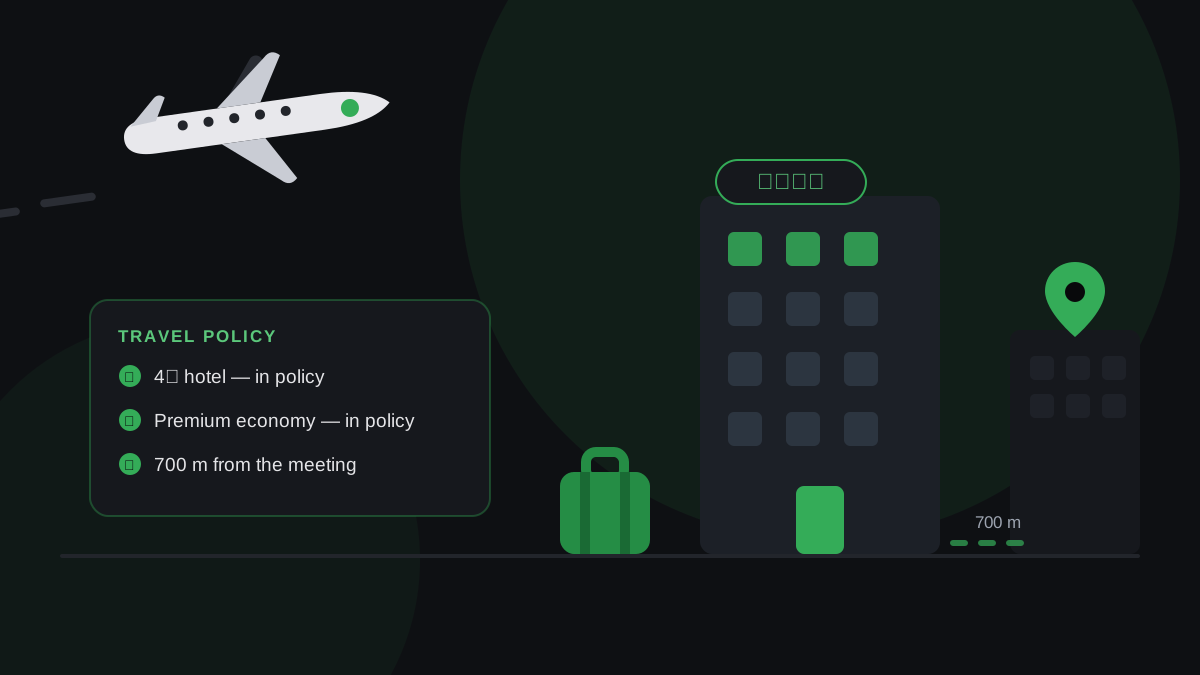
Corporate travel is the most rule-bound purchase in business. There’s a policy document that says which hotel stars you’re allowed, which cabin you fly by route length and grade, how far from the client you may sleep, which vendors are preferred, and what the nightly cap is in each city. Then a human being spends forty-five minutes on a booking site trying to hold all of those rules in their head at once, at 6pm, the night before the trip.
Rules that precise aren’t a burden to an agent. They’re a brief.
The policy is the brief
When an Orchard28 Travel Agent books a trip, your company’s travel policy translates directly into the agent’s hard constraints — the same condition-gate machinery we use for every autonomous run:
- Hotel quality: 4★ maximum (or minimum), from the approved chains, under the city’s nightly cap.
- Cabin class: premium economy over six hours, economy under it, exactly as the policy grid says.
- Proximity: within a kilometre of the meeting venue, because the policy values your morning more than a marginal saving across town.
- Timing: arrive the evening before the 9am, out on the last sensible flight after the close.
Here’s the part that matters: the agent doesn’t try to follow policy. It can’t book outside it. An out-of-policy hotel fails the condition gate the same way an over-cap price does — the booking simply never happens. Policy compliance stops being a thing to audit after the fact and becomes a property of the transaction itself.
The optimum pick, without the second-guessing
Anyone who books their own travel knows the low-grade anxiety of did I pick well? Three tabs of hotels, a map, a review site, and a nagging feeling on checkout that the better option was one page back.
The agent scores every in-policy candidate — total cost, walk time to your meeting, review quality, cancellation flexibility, your saved preferences (quiet room, gym, late checkout) — and commits to the best one, with the ranked runners-up held in reserve. You don’t have to trust its taste; you can read its reasoning in the audit trail. But after a few trips, most people stop reading. That’s the point: not having to worry that the optimum hotel was picked is the product.
One tap of the corporate card, and you’re done
Before the agent starts, you prime the run: the trip brief, the policy limits, and your corporate card — approved in a single tap. That one authorisation covers the whole trip, capped to the trip budget, with every booking running on a single-use card scoped to each vendor.
And then — this is the whole pitch — you do nothing else. The agent books the flight and the hotel inside your caps, on single-use virtual cards scoped to each vendor. No checkout forms, no card number read over the phone to a hotel, no waiting on a travel desk callback. You packed; the trip booked itself around your calendar.
The $53 you stop spending on every booking
Booking travel through humans has a real, countable cost. Put a traditional agency-assisted booking next to an agent run:
- Agency and transaction fees — a travel management company typically charges $25–35 per booked trip.
- Employee time — self-booking instead? Reckon 30–45 minutes of a salaried employee fighting comparison sites, which finance never sees as a line item but pays for anyway.
- Corrections and rebookings — mis-keyed dates, out-of-policy picks that bounce back from approval, the odd non-refundable mistake.
Net it out and we estimate about $53 saved per booking when a human doesn’t have to make it — before you count the softer wins, like the traveller getting their evening back and the trip being right the first time. For a company running two hundred trips a year, that’s north of $10,000 of pure booking friction, gone.
The paperwork files itself
The quiet second act of every agent-booked trip is the messaging that nobody has to write:
- Accounting receives the receipts, itemised and coded to the right cost centre and trip ID, the moment each booking settles — the expense report is effectively pre-filed.
- The employee’s manager gets a one-line confirmation: booked, in policy, inside budget, no exceptions to approve. (Only exceptions ever need a human decision — and with hard condition gates, there are almost none.)
- The traveller gets the itinerary in their inbox and their calendar: flights, hotel, confirmation numbers, and the walking route to the meeting.
Every message links back to the run’s audit trail — what was searched, what was shortlisted, why the pick won, and the authorisation behind the payment. When the quarterly compliance review comes around, the evidence isn’t assembled; it already exists, booking by booking. The reporting burden doesn’t shrink so much as disappear into the transaction.
The travel desk of one
Corporate travel was the first category we built the Travel Agent for, precisely because it’s where the rules are already written down. If your company can express its policy on a page, an agent can enforce it perfectly, book against it optimally, pay inside it safely — and hand back roughly $53 and an evening, every single trip.
Your next business trip doesn’t need a travel desk. It needs a brief, a cap, and a single tap to approve.