· agentic-commerce · payments
You Don’t Pay the Driver: Why the Merchant of Record in Agentic Commerce Will Be a Third Party
Uber settled the question of who signs the receipt a decade ago. Agentic commerce inherits the same answer — and the lift to make it work today is smaller than it looks.
David Broderick Founder & Head of Agents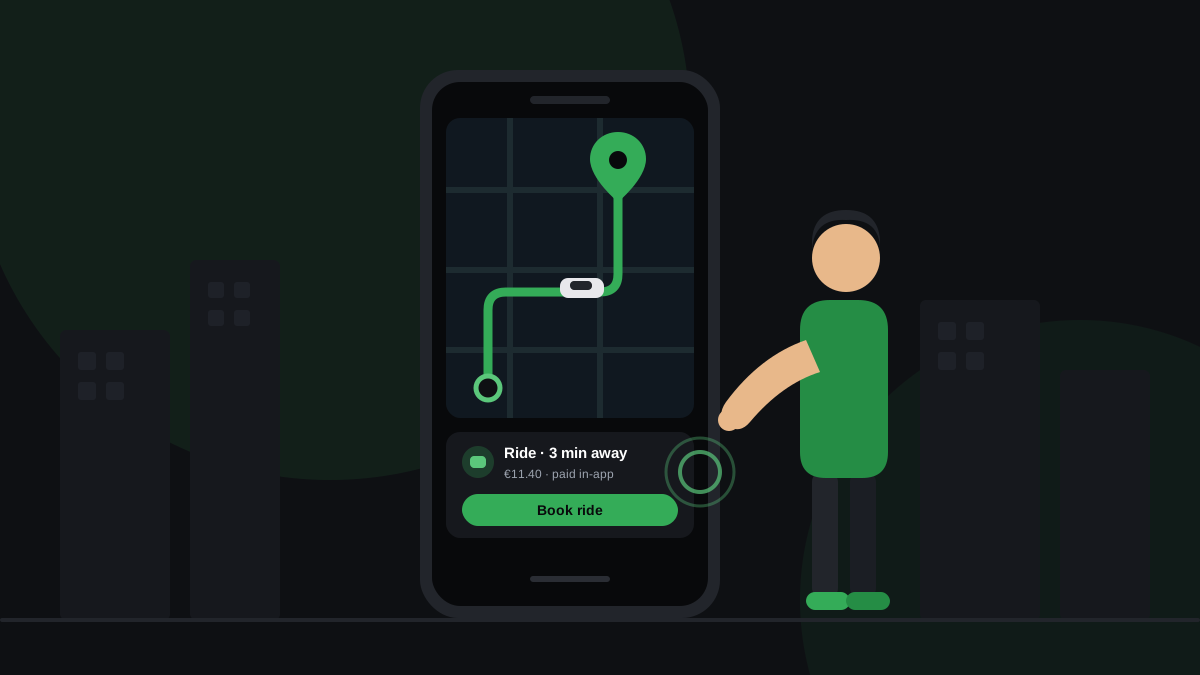
Think about the last ride you hailed. You tapped a button, a car appeared, you got out at the other end — and at no point did you hand the driver money, read their card terminal’s fine print, or wonder who to call if the fare was wrong. You paid the app. The app paid the driver. If anything went sideways, the app made it right.
In payments language: the platform, not the driver, is the merchant of record. And we think that single design decision — more than the map, more than the surge algorithm — is what made ride-hailing feel safe enough for a billion people to get into strangers’ cars.
Agentic commerce is about to rediscover the same answer.
What the merchant of record actually signs up for
“Merchant of record” sounds like accounting trivia. It isn’t. The MoR is the party whose name is on the transaction — and with the name comes the job:
- it processes the payment and its fees;
- it calculates and remits the taxes;
- it issues the receipt;
- it owns refunds, chargebacks and fraud liability;
- it answers the regulator, and it answers you.
When you buy from a shop, the shop is the MoR and you carry the burden of trusting it. When you ride with Uber, Uber is the MoR and the driver is a supplier. You never had to underwrite the driver — the platform did it for you.
Now put an agent in the loop
An agent that shops on your behalf might touch a dozen merchants in one afternoon: a hotel in Lisbon, a ticket outlet you’ve never heard of, a spare-parts retailer three countries away. Here’s the uncomfortable question: whose checkout do you trust?
You can’t vet them — you weren’t even present for the transaction. The entire premise of agentic commerce is that you delegated the shopping trip. And a delegation model where the human still has to individually trust every counterparty the agent picks is not delegation; it’s homework with extra steps.

So the trust has to consolidate somewhere, and there’s only one natural place: the platform that dispatched the agent. In agentic commerce the third party — the dispatch platform — becomes the merchant of record, exactly as Uber did for rides:
- One counterparty. You transact with the platform, whatever the agent bought and wherever it bought it. One name on your statement, not twelve.
- One receipt. The platform issues it, alongside the audit trail of what the agent searched, shortlisted and chose.
- One refund path. The pick was wrong, the merchant didn’t deliver, the price didn’t match? You take it up with the platform, which has both the leverage and the records to resolve it upstream.
- One liability holder. Fraud, disputes, chargebacks — they land on the party that ran the transaction, not on the person who was asleep when it happened.
The merchant behind the scenes becomes what the driver is to Uber: the supplier of the underlying service, paid reliably by the platform, relieved of the retail-facing risk.
The lift is smaller than it looks
Here’s the part that surprises people: making this work does not require inventing anything. Every component is already on the shelf, battle-tested by a decade of marketplaces:
- The money rails exist. Single-use virtual cards — capped to the approved amount, scoped to one merchant, dead after one use — are a commodity product on the Visa, Mastercard and American Express networks. This is how our transaction layer works today.
- The MoR machinery exists. Uber, the app stores, and every marketplace that came after them normalised the legal and tax framework for “platform transacts, supplier fulfils.” Payment providers now sell merchant-of-record capability as a product.
- The consumer contract exists. “Pay the app, not the driver” required a decade of consumer re-education — and Uber already paid for it. Nobody needs to be taught the model again; they need to be shown it applies to buying.
That’s why we describe it as a lift, not a moonshot. The Uber operating model — request in, dispatch out, platform holds the payment and the accountability — lifts almost unchanged onto agentic commerce. The agent replaces the driver’s steering wheel; the approval layer replaces the fare screen; the condition gate replaces the meter. The commercial chassis underneath is the same vehicle.
What merchants get out of it
The reflex objection is that merchants lose the customer relationship. The drivers’ version of that objection was raised in 2012, and the answer turned out to be volume: platforms deliver demand that individual suppliers could never reach. A merchant selling to an Orchard28 agent gets a buyer that never abandons a cart, never fat-fingers a card number, pays instantly from a pre-authorised instrument, and never files a fraudulent chargeback. Professional demand, guaranteed settlement, zero checkout friction. Most suppliers take that trade.
The road already has lanes
Every platform shift looks like a regulatory and operational mountain until someone notices the road has already been built. Ride-hailing built this one: third-party merchant of record, supplier network behind it, trust concentrated in the dispatcher, accountability priced into the fee.
Agentic commerce doesn’t have to wait for new rails, new law, or new consumer habits. It has to do what Uber did: pick up the model that’s sitting there, and drive.