· merchants · chargebacks · agentic-commerce
The Chargeback That Ruins Your Evening: What Honest Merchants Actually Go Through
The goods are gone, the money is clawed back, the fee lands anyway — and now you have three weeks to prove your innocence. A look at the human cost of chargebacks, and the better way agentic commerce can treat sellers.
David Broderick Founder & Head of Agents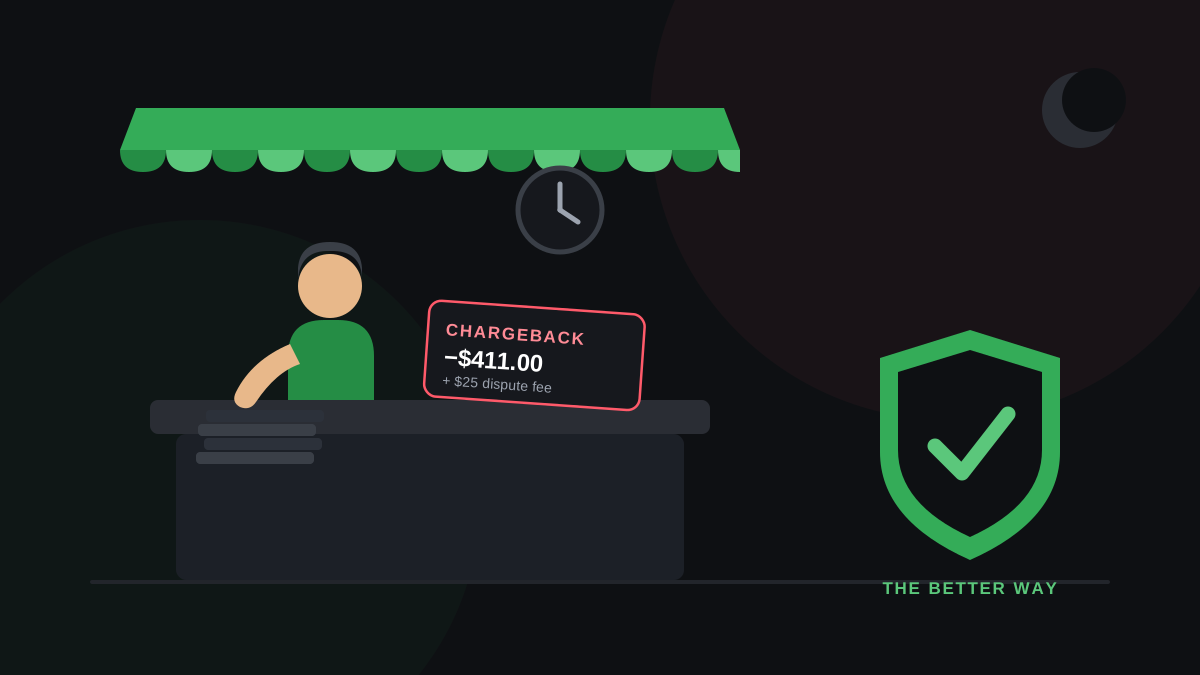
The email arrives at 9:40 on a Tuesday evening, after the shutters are down and the till is counted. A dispute has been opened against transaction #48211. Amount: $411. Reason code: transaction not recognised.
You know the order. You remember packing it. The tracking shows it delivered, signed for, eleven days ago. You did absolutely everything right — and you have just become the defendant.
Anyone who has run a shop, a site, or a stall knows the feeling that follows. It isn’t just about money. It’s the specific, cold unfairness of being presumed guilty by a system you can’t talk to, for something you didn’t do.
Count what one chargeback actually takes
Walk the ledger, because the damage is layered:
- The sale is gone — twice. The goods left your shelf and won’t come back. Then the revenue is clawed out of your account while the dispute runs. You are now down the product and the payment, financing your own accusation.
- The fee lands regardless. A dispute fee — typically $15 to $25 — is charged the moment the case opens. Win the dispute later and the fee usually stays. You paid a toll for being accused.
- The ratio ticks up. Every dispute, justified or not, counts against your chargeback ratio. Drift toward the card schemes’ monitoring thresholds — roughly one percent — and the letters start: excessive-dispute programmes, remediation plans, monthly scheme fines that punish you for other people’s claims. This is the part that keeps honest sellers up at night: you can be fined, escalatingly, for events you didn’t cause and couldn’t prevent.
- The clock starts. You have a response window measured in days to compile “compelling evidence”: order records, delivery confirmation, the customer’s IP and device data, correspondence, signatures, screenshots of your own returns policy. Sellers routinely spend two to four hours per dispute assembling this file — unpaid, after hours, in a portal that feels designed for someone else. And for card-not-present disputes, you do all of it knowing the odds: merchants lose most of them anyway.
Now multiply by every dispute in a busy month. The spreadsheet says it’s a few hundred dollars. The person says it differently: I stayed up until midnight three nights this week defending sales I already made.
What it does to a person
Talk to merchants about chargebacks and the vocabulary isn’t financial — it’s emotional. Kafkaesque. Guilty until proven innocent. Shouting into a void. The dispute process inverts everything a seller believes about their own integrity: you shipped the right item, on time, to the right person, and the system’s opening position is that you are the problem.
So honest merchants adapt in the saddest possible way: they get suspicious. They block countries. They refuse orders that look “too fast” or “too clean.” They add friction to checkout that costs them real customers, because the memory of the last dispute outweighs the value of the next sale. Fear of the chargeback quietly taxes every future transaction.
And that is exactly the posture merchants are in when agentic commerce knocks on the door. Software that buys “too fast” and “too clean”? A charge the cardholder might not recognise three weeks later? To a seller who has lived the Tuesday-evening email, agent traffic doesn’t look like the future — it looks like the dispute queue growing a new head. As we’ve written before, early adopters of agent-initiated checkout are reporting exactly that: chargeback rates at multiples of their baseline, driven by unrecognised transaction claims.
The better way: the dispute never reaches you
We designed Orchard28 so that a seller never has to have that evening. Not “fewer disputes” — a different shape of transaction entirely:
- You sell to us, not to a stranger’s software. Orchard28 is the merchant of record. The counterparty on the order is a platform with a name, a balance sheet, and an interest in the relationship — and when a cardholder raises a question, it comes to us, not to your dispute portal. Your evening stays yours.
- The authorisation is unarguable. Every run is authorised by the cardholder personally, up front — this exact purchase, inside the cap and window they set. “I don’t recognise this” is answered by a timestamped record of the cardholder authorising precisely this run, matched to the charge that followed.
- The payment can’t go wrong by construction. You’re paid from a single-use virtual card, scoped to you, funded to the exact amount. No insufficient funds, no stolen card numbers, no fat-fingered digits — the categories that generate disputes simply don’t occur.
- The evidence exists before anyone asks. Every run carries its audit trail — the brief, the shortlist, the selection, the authorisation — assembled automatically at transaction time, not reconstructed at midnight from six systems. If a question is ever raised, the file is already complete, and answering it is our job.
- Your ratio is protected. Disputes that never open never count. Selling to Orchard28 agents doesn’t inch you toward a monitoring programme — it moves volume out of the risky column entirely.
Sell, and sleep
There’s a version of agentic commerce where merchants brace against it the way they brace against bots — and the whole promise dies at the checkout. And there’s a version where an agent order is the safest sale of the day: authorised beyond argument, funded exactly, documented completely, with a platform standing in front of the seller instead of hiding behind a reason code.
Honest merchants have absorbed the cost of other people’s disputes for decades and called it the price of taking cards. It doesn’t have to be the price of taking agents. The 9:40 email, the clawed-back $411, the fee for being accused, the fine for something you didn’t do, the midnight evidence hunt — that’s the old shape of the problem.
The better way is simple to state: the dispute never reaches you. That’s what we built.