· merchants · chargebacks · small-business
Guilty Until Proven Shipped: Chargeback Defence for Small Businesses, Solved at the Source
For a small business, a chargeback is a trial where you gather your own evidence at midnight. Orchard28 runs collect that evidence for you — at hailing, at payment, and at completion — so the defence is written before the accusation arrives.
David Broderick Founder & Head of Agents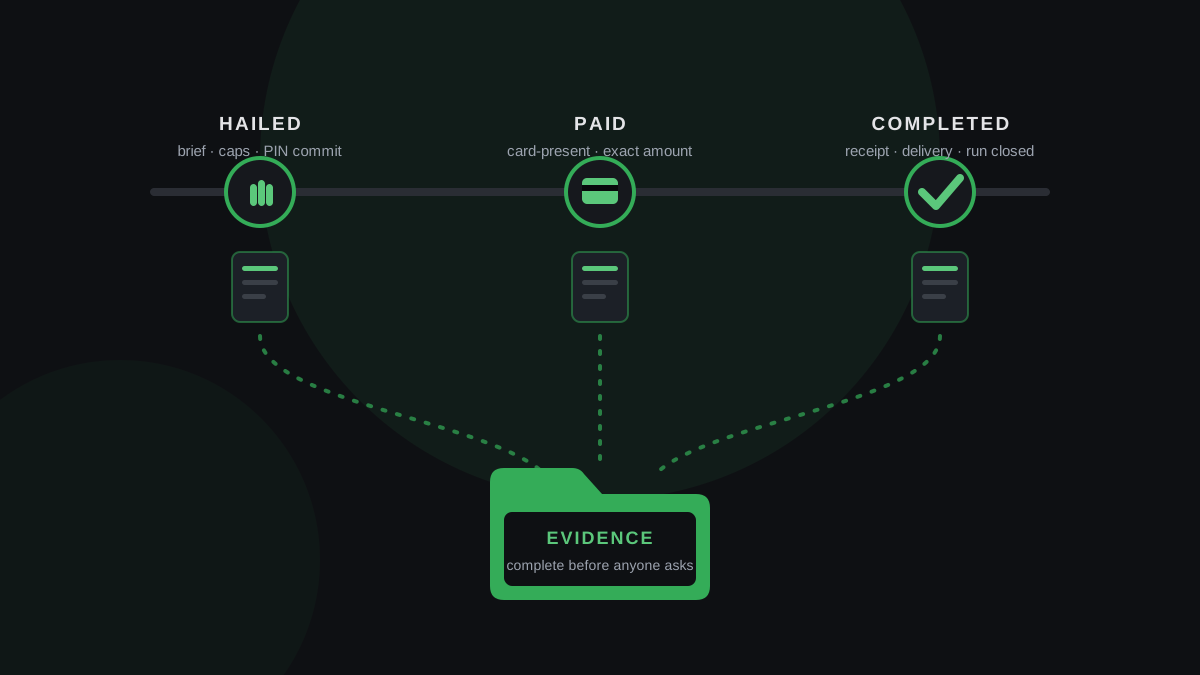
There’s a moment every small-business owner who takes cards eventually meets. The dispute notice is open on the laptop, and the portal is asking for things: proof of authorisation. Proof of delivery. Device fingerprint. Correspondence history. Evidence of cardholder participation.
And the owner of the two-person pottery studio, or the family bike shop, or the one-woman print store sits there thinking: I sold a mug. I don’t have a device fingerprint. I have a till receipt, a courier note somewhere in a drawer, and a customer email address. The evidentiary standard was written for enterprises with fraud teams; the person being asked to meet it does their bookkeeping on Sunday nights.
We wrote recently about what a chargeback takes out of a merchant emotionally — the clawed-back sale, the fee for being accused, the scheme fines for things you didn’t do. This piece is about the other half of the injustice: the defence. Because for a small business, losing the money is only part of it. The deeper hurt is knowing you’re innocent and being unable to prove it — not because the proof doesn’t exist, but because it was never captured, and you were never told you’d need it.
Why small businesses lose winnable disputes
Talk to dispute specialists and they’ll tell you the quiet truth: small merchants don’t lose chargebacks because they’re wrong. They lose because of evidence logistics.
- The proof is scattered — order data in one system, payment data at the processor, delivery data with the courier, conversation history in a personal inbox.
- The proof is perishable — courier tracking pages expire, session logs rotate, memories fade by the time the dispute lands weeks later.
- The proof was never collected — nobody photographs the parcel or logs the customer’s device on the day everything goes right, and every day it goes right until it doesn’t.
- And the assembly happens on the defendant’s time — hours per case, against a deadline, in a portal, after close.
A big retailer solves this with software and a disputes team. A small business solves it by absorbing the loss and quietly hating the system. That’s the status quo agentic commerce inherits — unless the evidence problem is solved where it actually occurs: at transaction time.
An Orchard28 run testifies for you
Here’s the thing about a purchase made through an Orchard28 agent: it is the most thoroughly witnessed sale a small business will ever make. Not because anyone set out to do paperwork, but because the run is the paperwork. Evidence accrues at all three moments of the run’s life:
At hailing. The run begins with a human being stating exactly what they want — the brief, the constraints, the budget cap, the time window — and then authorising it personally. Before an agent has taken a single step, there is a timestamped, tamper-evident record of who authorised what, up to how much, and until when. That single artefact answers the question most disputes turn on — “did the cardholder actually authorise this?” — with a definitive, contemporaneous record of the cardholder doing exactly that.
At payment. When the agent buys, the payment itself is evidence. A single-use virtual card is issued against that authorisation — scoped to your shop, funded to the exact amount, dead after settlement. The charge that lands in your account is chained back to the cardholder’s own authorisation: this run, this cap, this merchant, this amount, inside this window. There is no gap between “what was authorised” and “what was charged” for a dispute to live in.
At completion. The run doesn’t end at checkout. The agent collects the confirmation, the receipt, the tracking and delivery evidence, and files the lot back — to the customer and into the run’s permanent audit trail — before closing the run as fulfilled. The loop is closed while the courier page still works and the confirmation email is still warm: outcome, matched against brief, documented at the moment of truth rather than reconstructed a month later.
Hailing proves intent. Payment proves authorisation. Completion proves fulfilment. Those are the three pillars of every chargeback defence ever written — captured automatically, in order, by the transaction itself.
What a dispute looks like when the file already exists
First, remember who answers the door: Orchard28 is the merchant of record, so a cardholder’s question comes to us, not to your dispute portal — most sellers will simply never see it. But the fairest way to show the difference is to imagine the worst case anyway and put the two defences side by side.
The old way: a small-business owner spends two evenings excavating six systems, hoping the tracking link still resolves, writing a cover letter to an issuer who has seen ten thousand of them, and losing anyway because one artefact — the proof of authorisation, the one thing they never had — is missing.
The Orchard28 way: the run’s dossier — brief, authorisation, scoped payment, receipt, delivery confirmation, closure — already exists as a single coherent record, assembled in real time by the platform whose job it was to witness everything. Answering a dispute stops being an investigation and becomes an attachment. Minutes, not evenings. And because the authorisation pillar is the cardholder’s own recorded commitment rather than an inference, it’s the kind of file that ends disputes rather than argues them.
Small shops deserve big-company armour
The cruel asymmetry of the chargeback system is that the smaller you are, the more each dispute costs you and the less machinery you have to fight it. Agentic commerce is a chance to flip that — to make the sale itself generate the armour, so a two-person studio walks into any dispute with a better evidence file than a supermarket chain.
That’s what we built. Hail, pay, complete — witnessed at every step, filed before anyone asks. Sell to an agent, and if the accusation ever comes, the defence has been sitting in the drawer since the moment the sale was made. That, for a small business, is the difference between dreading the dispute email and barely noticing it.