· payments · stablecoins · agentic-commerce · merchants
Orchard28 Will Settle in Open USD: A Merchant-First Stablecoin for Agentic Commerce
Open USD is a low-cost, openly governed stablecoin backed by a 140-partner consortium including Visa, Mastercard, BlackRock and Stripe. Here's why Orchard28 is adding it as a settlement rail — and why it's good for the merchants our agents buy from.
David Broderick Founder & Head of Agents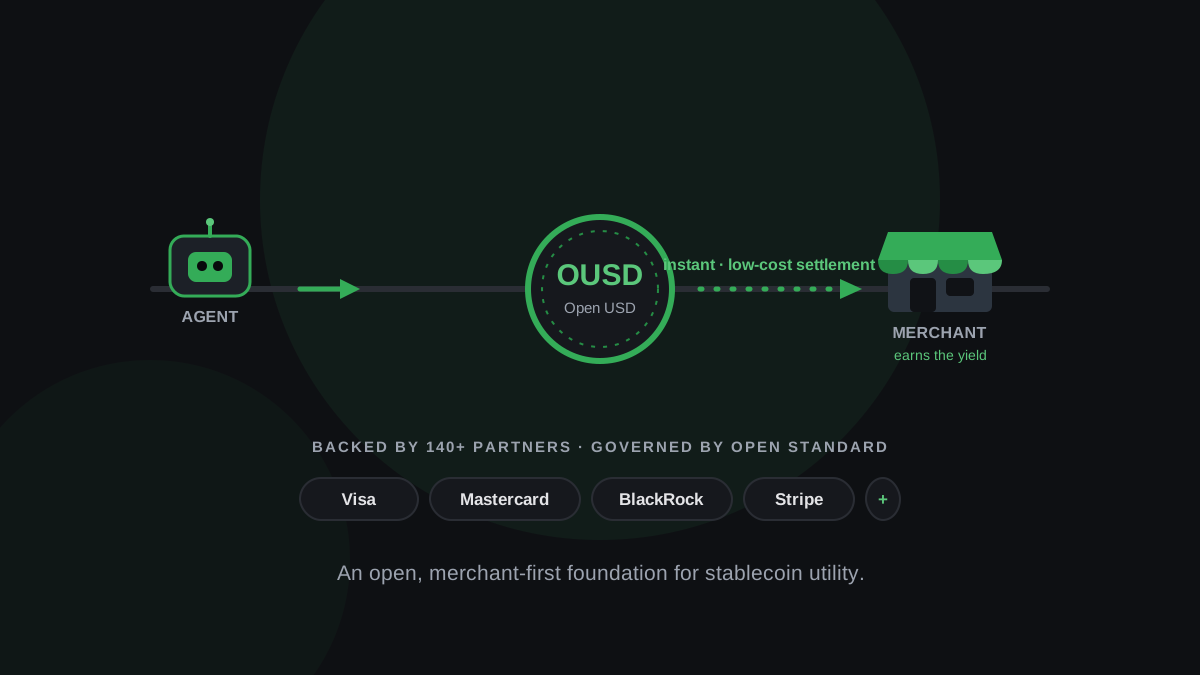
Every so often the plumbing of money shifts, and it pays to notice early. Open USD is one of those shifts — and Orchard28 is building to accept and settle in it.
What Open USD is
Open USD (ticker OUSD) is a US-dollar stablecoin launched by Open Standard, a consortium of more than 140 financial and technology companies. The backer list is not the usual crypto crowd — it’s the establishment: card networks Visa, Mastercard and American Express; asset manager BlackRock; fintechs Stripe and Chime; crypto firms Coinbase and Ripple; payments processor Adyen; and banks including BNY, U.S. Bank, Huntington and Citizens. It’s governed collectively through Open Standard — led by Bridge CEO Zach Abrams — with a board drawn from partner members rather than a single issuer calling the shots.
That governance detail is the whole point. Most stablecoins are a product: one company issues the token, holds the reserves, and keeps the interest those reserves earn. Open USD is structured more like shared infrastructure. In the words of one founding partner, the aim is to build “an open, merchant-first foundation for stablecoin utility” — and that framing is exactly why it caught our attention.
Why it costs less to accept
Agentic commerce runs on volume. When an agent does the buying, transactions happen more often, at machine speed, across many merchants. At that scale the cost of moving money stops being a rounding error and becomes a design constraint. Open USD attacks that cost from three directions:
- No interchange, instant settlement. A card payment carries interchange and takes days to settle; an Open USD transfer settles in real time and costs a fraction to accept. For a merchant, faster money at lower cost is simply a better deal.
- Mint and redeem at no cost, with no volume caps. Businesses can move in and out of the token freely, so it behaves like working capital rather than a toll booth.
- Merchants earn the yield on their own balances. This is the quiet revolution. Today a merchant’s float earns them nothing — the issuer keeps the interest. Under Open USD, reserve earnings flow back to the partners and businesses holding the token, after a management fee. The money you hold works for you.
Lower cost to accept, instant settlement, and yield on balances that used to be dead weight — that’s a materially better economic position for the seller on the other side of an agent’s purchase.
Why this fits Orchard28
We’ve written a lot on this blog about being good to merchants — why the merchant of record should be a third party, what a chargeback does to an honest business, and how our evidence trail defends them. Supporting a merchant-first settlement rail is the same conviction, one layer down.
Here’s how Open USD slots into the Orchard28 model:
- You still hold the controls. Open USD is a settlement rail, not a change to how you authorise. Every run is still approved in the moment or pre-authorised under hard caps, still runs on a capped single-use card scoped to the merchant, and is still backed by a full audit trail. Adding a stablecoin option doesn’t loosen a single guardrail.
- Cheaper rails mean more of your money reaches the merchant. When settlement costs less, there’s less friction skimmed out of every purchase your agent makes — value that stays in the transaction rather than leaking to intermediaries.
- Instant settlement suits autonomous speed. An agent that can buy concert tickets in 800 milliseconds shouldn’t be waiting three days for the money to land. Real-time settlement matches the tempo of the runs.
- Open governance matches our stance. We don’t think the rules of agentic commerce should be owned by one company — a theme we return to constantly. A stablecoin governed by its users, not its issuer, is the payments expression of that same idea.
The honest caveats
Two things worth saying plainly. First, Open USD is new — Open Standard has signalled a 2026 rollout without a firm date, and we’ll turn on settlement support in step with its availability and our own early-access waves. This is a direction we’re committing to, not a live button today. Second, a stablecoin is only as trustworthy as its reserves, its governance and its regulatory footing; the calibre of the backers and the collective governance model are encouraging, but we’ll hold Open USD to exactly the same bar — PCI-grade security, clean audit trails, real accountability — that we hold every other rail.
Where this goes
The card networks that helped build Open USD are the same networks Orchard28 already settles on today, which tells you something: this isn’t crypto versus cards, it’s the incumbents and the innovators agreeing on cheaper, faster, more open rails. That’s the right kind of shift, and agentic commerce — high-frequency, merchant-sensitive, machine-speed — is exactly the workload that benefits most.
You’ll keep setting the destination and tapping to approve. Increasingly, what happens underneath will settle in something faster and fairer than it did before — and the merchant your agent bought from will be a little better off for it.
Sources: Banking Dive, The Defiant.